
Protecting Water is Protecting Civilians: Prof. Mark Zeitoun at the 63rd UN Human Rights Council
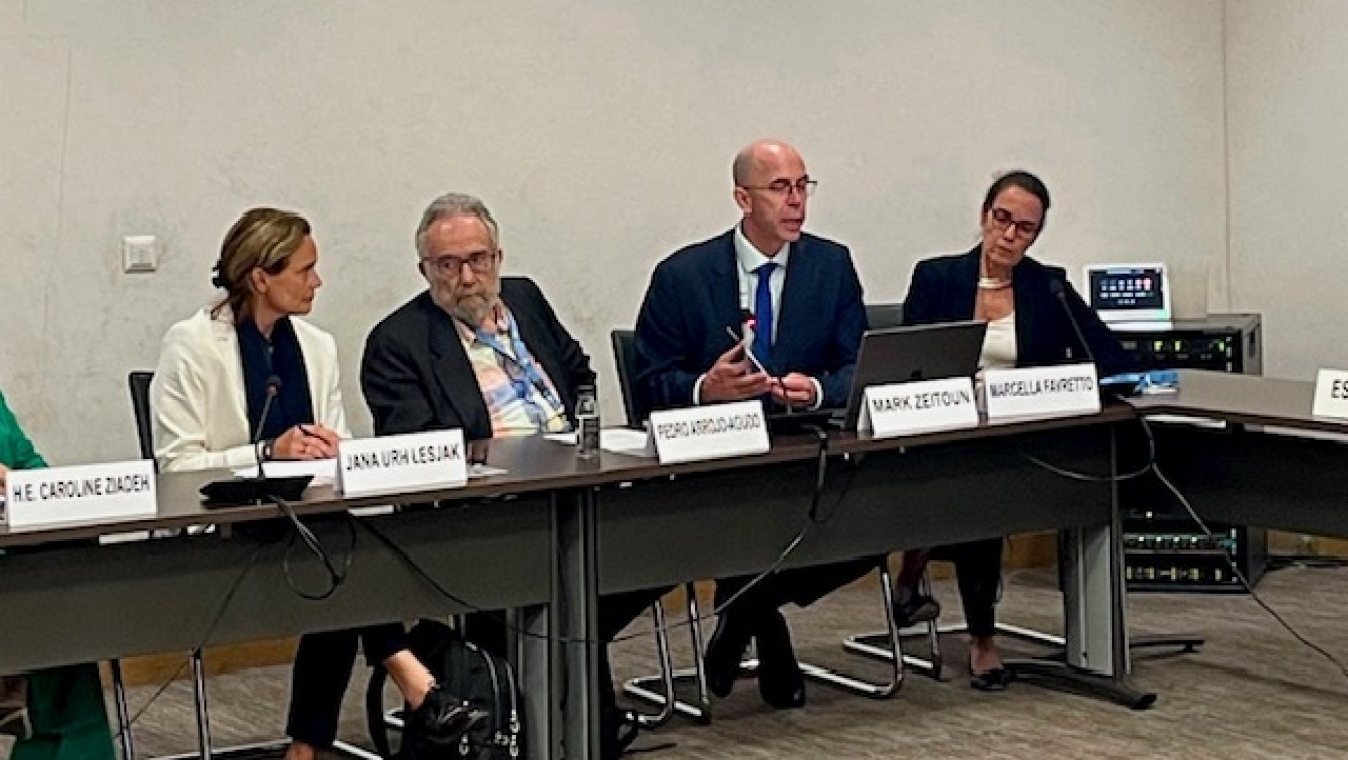
At the 63rd session of the United Nations Human Rights Council, our Director General Prof. Mark Zeitoun joined a high-level side event on "Human Rights to Water and Sanitation in Times of Armed Conflict" at the Palais des Nations in Geneva.
Convened by OHCHR and co-sponsored by the Permanent Missions of Spain, Germany, Lebanon, Slovenia and Bangladesh, together with the UN Special Rapporteur on the human rights to safe drinking water and sanitation, Mr. Pedro Arrojo-Agudo.
Alongside Ambassadors and experts including Prof. Ludovic Hennebel (CESCR), the panel was moderated by Ms. Marcella Favretto (OHCHR).
Two propositions from Prof. Mark Zeitoun:
- Protecting water is protecting civilians. You don't have to attack civilians directly to cause enormous civilian harm. Hit a pumping station, cut its electricity, damage a treatment plant – hospitals can't sterilise equipment, sanitation collapses, disease spreads. These are reverberating effects: civilian harm felt far beyond the blast zone, long after the dust has settled.
- The more we know, the harder it is to say "we did not know". Knowledge changes foreseeability. Under IHL rules on proportionality and precautions in attack, parties must account for reasonably foreseeable civilian harm, as captured in the Geneva Principles on the Protection of Water Infrastructure. From Ukraine to Gaza, Lebanon and the recent attacks on water and desalination infrastructure in Iran, the consequences were not only foreseeable — they were foreseen.
Principle must become practice through two key opportunities: the Global Alliance to Spare Water from Armed Conflicts (GASWAC) – co-chaired by Slovenia and Switzerland, with the Geneva Water Hub as Secretariat – and the UN 2026 Water Conference in Abu Dhabi, where armed conflict must not be treated as somebody else's problem.
From the floor:
Slovenia underlined the water and peace nexus and its role as Chair of the Group of Friends on Water and Peace.
Moldova asked for examples where water plays a positive role. Prof. Zeitoun's response: water is a powerful tool for peace and mediation. Systems often cross conflict lines, and technical cooperation can open the door to broader diplomatic dialogue, as seen in Syria.
Germany, in closing, paid tribute to Special Rapporteur Pedro Arrojo-Agudo on his final HRC session and reaffirmed that water must never be used as a weapon against civilians.
When we know what happens to civilians when the water stops, "we did not know" is no longer good enough.