
Les conséquences invisibles de la guerre : la résistance aux antimicrobiens dans des réseaux d'approvisionnement en eau fragilisés
La résistance aux antimicrobiens (RAM) constitue une menace silencieuse et transfrontalière. Les infections résistantes aux médicaments ont été associées à près de 5 millions de décès dans le monde en 2019, un bilan qui pourrait atteindre 10 millions par an d'ici 2050 si aucune mesure n'est prise (PNUE, 2022).
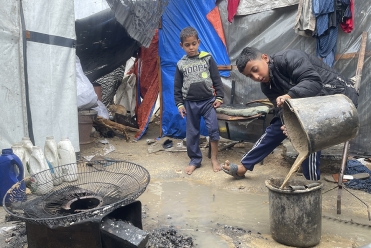
Dans les contextes fragiles et touchés par des conflits (FCAS), les risques s’aggravent considérablement. Les infrastructures WASH endommagées, l’infiltration des eaux usées dans les abris pour personnes déplacées, la perturbation des soins de santé, l’effondrement de la surveillance pharmaceutique et les capacités limitées des laboratoires créent, ensemble, des conditions particulièrement propices à l’émergence et à la propagation d’agents pathogènes résistants.
L'une des conclusions les plus frappantes de ce rapport est la suivante : l'eau peut présenter des résultats négatifs aux tests portant sur des indicateurs standard tels que E. coli tout en contenant néanmoins des bactéries résistantes aux antibiotiques et des gènes de résistance qui constituent une menace pour la santé publique — un phénomène observé à Gaza avant octobre 2023, où des souches résistantes de Pseudomonas spp. et de Staphylococcus aureus ont été détectées dans des échantillons jugés par ailleurs sûrs sur le plan microbiologique.
Pour faire face à cette crise cachée, cette note propose trois mesures politiques coordonnées s’inscrivant dans le cadre de l’approche « One Health »:
- Renforcer les infrastructures WASH et la gestion de l'eau potable ;
- Mise en place d'une surveillance intégrée de la résistance aux antimicrobiens dans l'eau et l'environnement ;
- Promouvoir la gestion responsable des antimicrobiens et les mesures de contrôle environnemental dans tous les secteurs.
Le mémoire rappelle également qu'en vertu du droit international humanitaire (Protocoles additionnels I et II aux Conventions de Genève, 1977), les infrastructures d'approvisionnement en eau et d'assainissement sont protégées en tant qu'éléments indispensables à la survie de la population civile.
Développé dans le cadre du projet JI-RISE (Jameel Institute – Real-time Intelligent Support for Emergencies), dirigé par l’ l’Imperial College de Londres et financé par la Community Jameel par l’intermédiaire du Institut Jameel, ce rapport a été co-rédigé par Reem Abu-Shomar (UNU-INWEH), Imane Messaoudi-Mattei et Mark Zeitoun (Geneva Water Hub), avec le soutien de l’ Agence suisse pour le développement et la coopération (DDC), de l’ Université de Genèveet de l' Institut universitaire de hautes études internationales de Genève.